
Climate Change

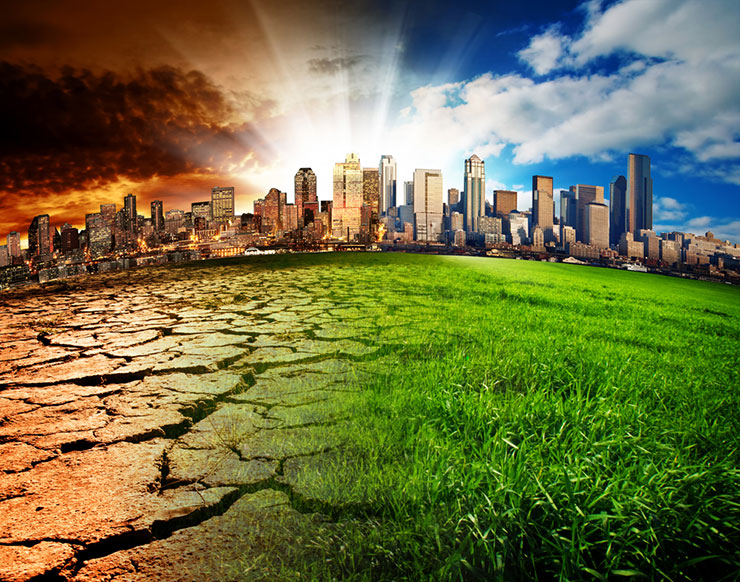
The Harsh Reality: Climate Change

"No challenge poses a a greater threat to future generations than climate change."
  -Barack Obama

 "Eleven percent of the world’s population (800 million people) is currently vulnerable to climate change impacts such as droughts, floods, heat waves, extreme weather events and sea-level rise."

The United Nations define climate change as (1)“a change of climate which is attributed directly or indirectly to human activity that alters the composition of the global atmosphere and which is in addition to natural climate variability observed over comparable time periods.”

Climate change has lead to drastic changes in nature.

A minor fluctuation in the temperature caused the once vibrant corals to bleach.

(2)“The first global scientific assessment of climate change impacts on World Heritage coral reefs, published in 2017 by UNESCO, predicts that the coral reefs in all 29 reef-containing World Heritage sites would cease to exist as functioning coral reef ecosystems by the end of this century if humans continue to emit greenhouse gases.”

Climate change is not a hoax it is a harsh reality we have no other option than to face and if we fail to do so the consequences are ones that are much graver than we presume and there is not a possibility of buying your way out of them, not in this situation.

Source: 

(1):https://unfccc.int/files/essential_background/background_publications_htmlpdf/application/pdf/conveng.pdf
(2):https://www.iucn.org/resources/issues-briefs/coral-reefs-and-climate-change


Image:

Follow Us on different media platforms: 

https://linktr.ee/_projectpalmtree


YOUR DAILY SOURCE OF INFORMATION! 

-Project Palm Tree


Comments

Popular posts from this blog

Discrimination

 Discrimination “Prejudice is a burden that confuses the past, threatens the future, and renders the present inaccessible.” -Maya Angelou Discrimination is defined as unequal treatment of various groups based on various factors. Title VII of the Civil Rights Act of 1964 states that it is “illegal to discriminate against someone on the basis of race, color, religion, national origin, or sex." Discrimination can be faced in any profession, in the workplace, and even in daily locations such as shops, restaurants, transport like buses or trains, and in sports. Discrimantion may take place in various forms such as direct, indirect and intersectional discrimination. The different types of discrimination include: Age, diability, and national,ethinic or immigrant origin discrimination Discrimination due to race, and colour Discrimination based on gender and sexual orientation Example: HIV related stigma and discrimination Discrimination can negatively impact ones health as an individual f...

Ageing population

  Ageing population "Every industry is going to be affected (by the aging population). This creates tremendous opportunities and tremendous challenges." -Pat Conroy " There were 703 million people aged 65 years or over in the world in 2019 and the number of older people is projected to double to 1.5 billion in 2050." Ageing population refers to the change in the age composition of a population such that there is an increase in the proportion of older people.  The average or median age or of the citizens of a country increases due to a longer life expectancy of its citizens of a lower birth rate per year. The provision of healthcare, as well as the improvement in it due to advancements in technology, have lead to a longer life expectancy, leading to a rising ageing population. The increase in the aged population does provide some economic advantages.  Due to older people having higher accumulated savings than younger individuals, a large ageing population can result ...

Refugees

 Refugees  " An estimated 30 – 34 million of the 79.5 million forcibly displaced persons are children below 18 years of age (end-2019)." “To be called a refugee is the opposite of an insult; it is a badge of strength, courage, and victory.” — Tennessee Office for Refugees A refugee is defined as " someone who has been forced to flee his or her country because of persecution, war or violence."  "A refugee has a well-founded fear of persecution for reasons of race, religion, nationality, political opinion or membership in a particular social group."  Refugees may have fled conflict, persecution or war, or violence and may have crossed borders in hopes to obtain safety.  They may flee with minimal resources such as clothes and food and often leave behind jobs, homes, possessions, and loved ones.  There are different types of refugee which include and why they may flee:  Religious or Political Affiliation Climate Change Stateless Persons Internally Displac...